Königsplatz
Back to all places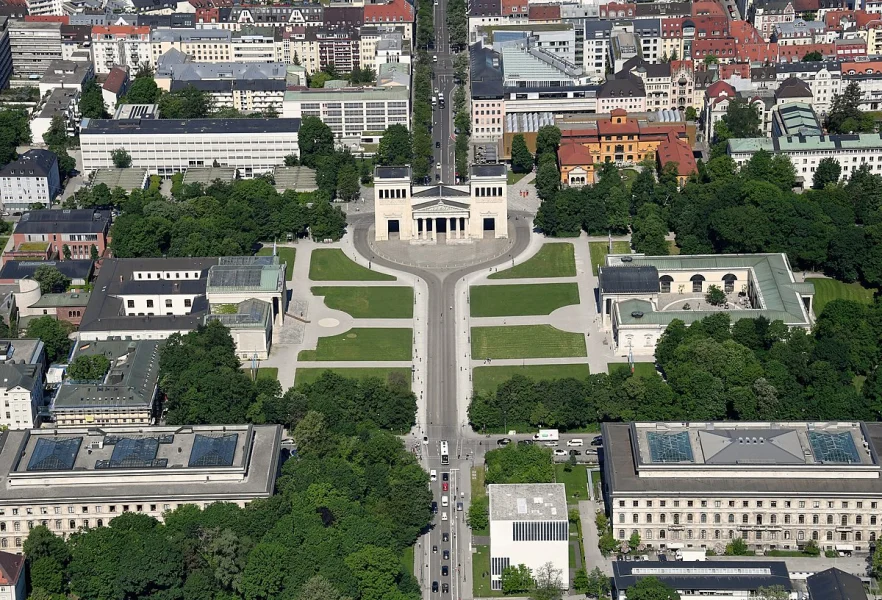
Königsplatz
0:00 / 1:26Königsplatz
Königsplatz in Munich stands as a grand testament to Neoclassical architecture and Bavarian history, conceived in the early 19th century as part of King Ludwig I’s vision to shape Munich into the “Athens of the Isar.” Designed primarily by the famed architect Leo von Klenze, construction began in 1816 and continued through the 1860s, culminating in the creation of the imposing Propylaea, the Glyptothek, and the State Collection of Antiquities. Königsplatz was modeled after ancient Greek public squares, and its precise arrangement of Doric, Ionic, and Corinthian columns demonstrates meticulous adherence to classical artistic principles. Over the decades, the square played a central role in Munich’s cultural and political life. It gained somber notoriety during the Nazi era, when it became the staging ground for mass rallies and public displays by the regime, including the “Day of the German Art” celebration in 1937. The square was also the site of the “Ehrentempel,” two Honor Temples constructed by the Nazis to commemorate the failed Beer Hall Putsch of 1923. After World War II, these structures were demolished, and Königsplatz underwent significant restorations to return it to its original function as an open civic space. Today, Königsplatz is renowned for its museums and cultural events, serving as both a vivid reminder of Munich’s artistic heritage and its complex historical legacy.
48.14604, 11.56438