Marienplaz
Back to all places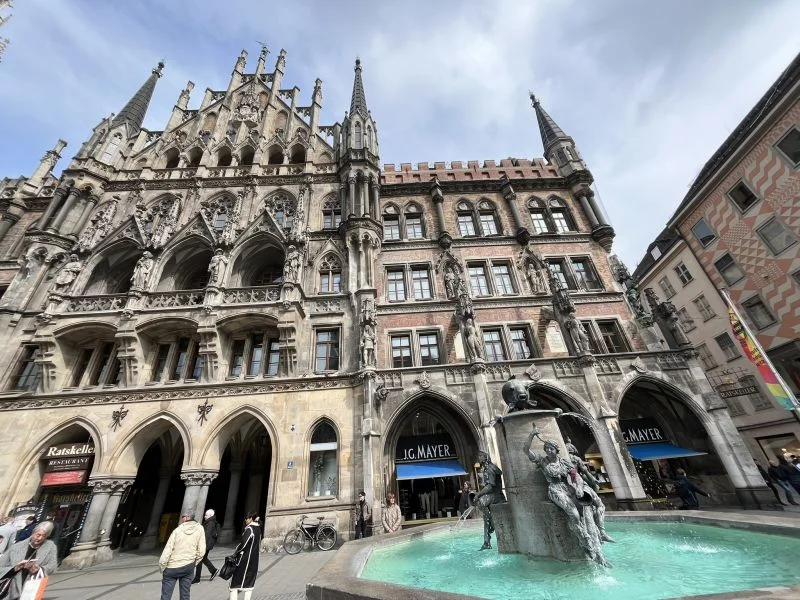
Marienplaz
0:00 / 3:32Marienplaz
Okay, gather ’round, let me tell you a story…
Once upon a time, many, many years ago, Munich was a much smaller town than it is today. And right here, where we’re standing on Marienplatz, was the heart of it all. Imagine a bustling marketplace, filled with the sounds of vendors hawking their wares, horses pulling carts, and the chatter of townsfolk. That was the scene back in the 12th century.
But life wasn’t always easy. In 1315, a terrible fire swept through Munich, leaving Marienplatz in ruins. But the city was resilient, and slowly, it rebuilt, shaping this square into something more permanent, more important.
Centuries passed, and the winds of war blew across Europe. During the Thirty Years’ War, Munich faced occupation by Swedish forces. Fear gripped the city, and the people prayed for salvation. In 1638, when the occupation finally ended, the city gave thanks. They erected a magnificent column, topped with a golden statue of the Virgin Mary, the patron saint of Bavaria. This Marian Column, or Mariensäule, became the heart of the square, a constant reminder of their gratitude and faith. Look closely at the base, you’ll see small cherubs battling evils!
Time moved on, and Munich grew. The marketplace, now too crowded for the growing city, was moved elsewhere in 1807. Marienplatz was becoming less about commerce and more about administration and symbolism. But this square was still missing something…
Then, in 1867, the construction of the Neues Rathaus, the New Town Hall, began. This wasn’t just any building; it was a statement, a testament to Munich’s wealth and power. Completed in 1909, this neo-Gothic masterpiece added a touch of fairytale charm to the already historic square.
And the best part? The Glockenspiel! Imagine, if you will, a grand wedding celebration, a jousting tournament between knights, all in honor of Duke Wilhelm V and Renata of Lorraine in 1568. Every day, twice or even three times a day during the summer, the Glockenspiel comes to life. The figures twirl and joust and dance, telling the story of Munich’s past!
But the Glockenspiel tells another story too - the legend of the Schäfflertanz. Back in 1517, when a terrible plague gripped Munich, fear kept everyone locked inside their homes. It was the coopers, the barrel makers, who dared to venture out, dancing through the streets to bring cheer and encourage people to live their lives again. Their dance is a symbol of hope and resilience, and you can still see it performed in Munich every seven years.
And speaking of legends, did you know that the Mariensäule stands as a reminder of a vow made during a time of war? It is said that the city promised to erect a column to the Virgin Mary if she spared Munich from destruction. And she did!
Oh, and before I forget, look at the entrance of the Frauenkirche nearby. There’s a dark footprint on the floor. Legend says that the devil promised to build the building without windows in a deal with the architect, but the architect cheated, the Devil got angry, and that is where his footprint comes from.
So, there you have it. Marienplatz isn’t just a square; it’s a living story, a tapestry woven with history, legends, and the spirit of Munich. Take a deep breath, soak it all in, and become part of the story yourself! What are you waiting for? Go explore!
48.13716, 11.57542